Multi-locus GWAS of Ethiopian sorghum landraces revealed extensive genetic variation and key candidate genes underlying root architectural traits, providing valuable targets for breeding drought-resilient, water-efficient sorghum cultivars.

Keywords: BiomaRt, LOD scores, ML-GWAS, Nodal root angle, QTNs, RSA, SNP

Ethiopia, a primary center of origin for sorghum, harbors extensive genetic diversity that underpins the crop’s resilience to abiotic stresses such as drought. This diversity offers an invaluable foundation for identifying genetic variants linked to drought adaptation, particularly root system architectural (RSA) traits critical for water acquisition. Through advances in high-throughput genotyping and multi-locus genome-wide association studies (ML-GWAS), researchers can now dissect the complex polygenic basis of traits like nodal root angle, root length, and root number with improved precision. In Ethiopian sorghum landraces, researchers from Addis Ababa University, Melkassa Agricultural Research Center, Jimma University and collaborating institutions used ML-GWAS to reveal rapid linkage disequilibrium decay, indicating a high level of genetic diversity and enabling the detection of 73 quantitative trait nucleotides (QTNs) distributed across all sorghum chromosomes. Notably, QTNs associated with root angle explained up to 15% of phenotypic variation, highlighting both the genetic complexity of this trait and its potential for marker-assisted selection (MAS).

Functional annotation and enrichment analyses revealed that candidate genes regulating RSA traits are involved in key biological processes, including transcriptional regulation, DNA repair, and hormonal signaling. Genes such as protein phosphatase 2C (PP2C) and cytochrome P450 were linked to drought-responsive pathways, while others, including E3 ubiquitin-protein ligase BRE1 and histone lysine demethylases, pointed to epigenetic mechanisms modulating stress responses. Correlations among RSA traits, such as between nodal root angle, root length, and plant height, underscore their coordinated control and pleiotropic genetic basis. Collectively, these findings illuminate the genetic architecture underlying drought tolerance in Ethiopian sorghum landraces and establish a genomic framework for developing climate-resilient, water-efficient sorghum cultivars through integrative breeding strategies.

SorghumBase Examples: 
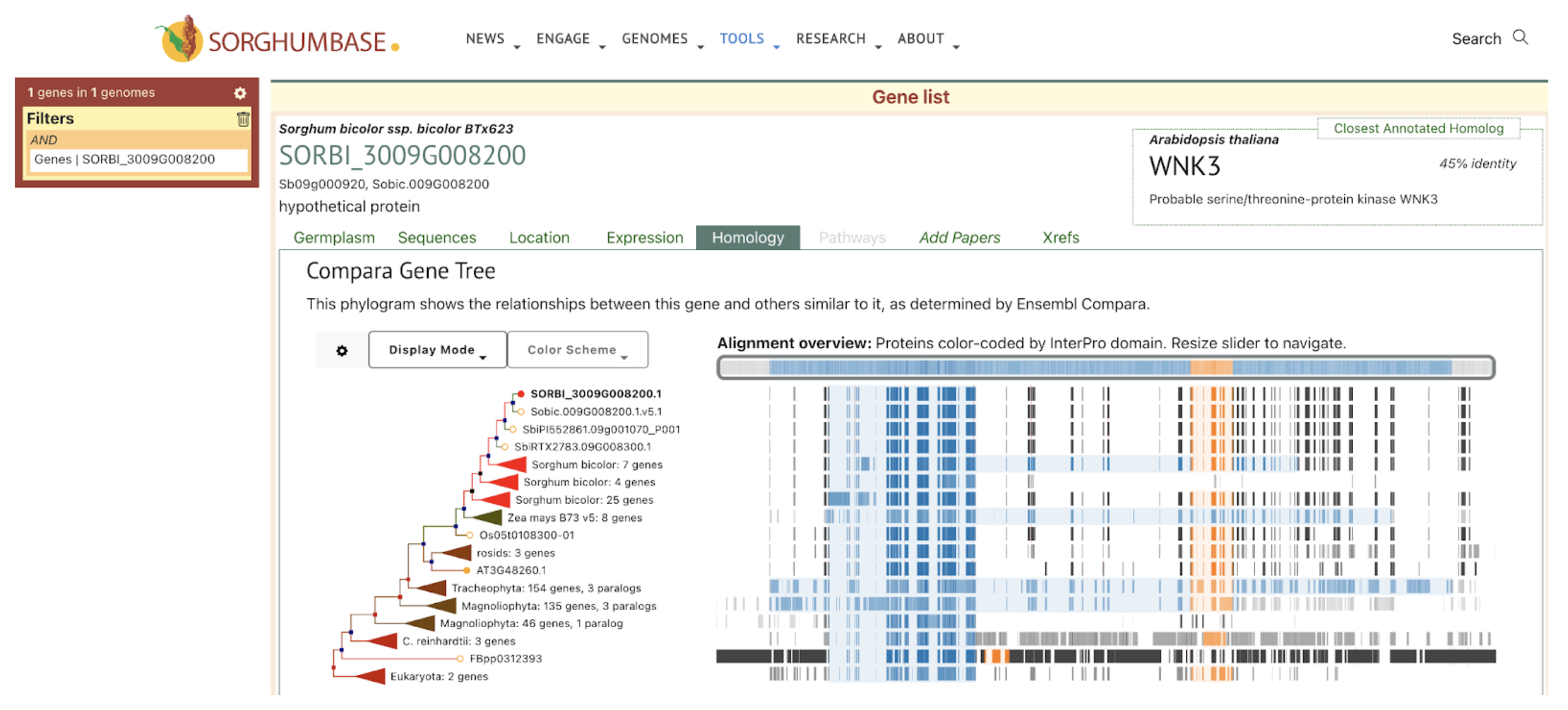
Figure 1: The authors examined SORBI_3009G008200, a Sorghum bicolor gene located on chromosome 9 and annotated as a hypothetical protein. Phylogenetic analysis in SorghumBase reveals its close relationship with homologous genes across major plant lineages, including Zea mays, Oryza sativa, and Arabidopsis thaliana. The closest annotated homolog, Arabidopsis WNK3, encodes a probable serine/threonine-protein kinase, suggesting that SORBI_3009G008200 may function as a WNK-like kinase involved in signal transduction. Gene clusters within Sorghum bicolor (containing 4–25 related paralogs) highlight lineage-specific expansions and possible functional diversification. The alignment overview (right panel) displays protein sequence conservation color-coded by InterPro domains, with blue regions denoting highly conserved kinase motifs and orange segments marking variable regions that may reflect adaptive divergence.
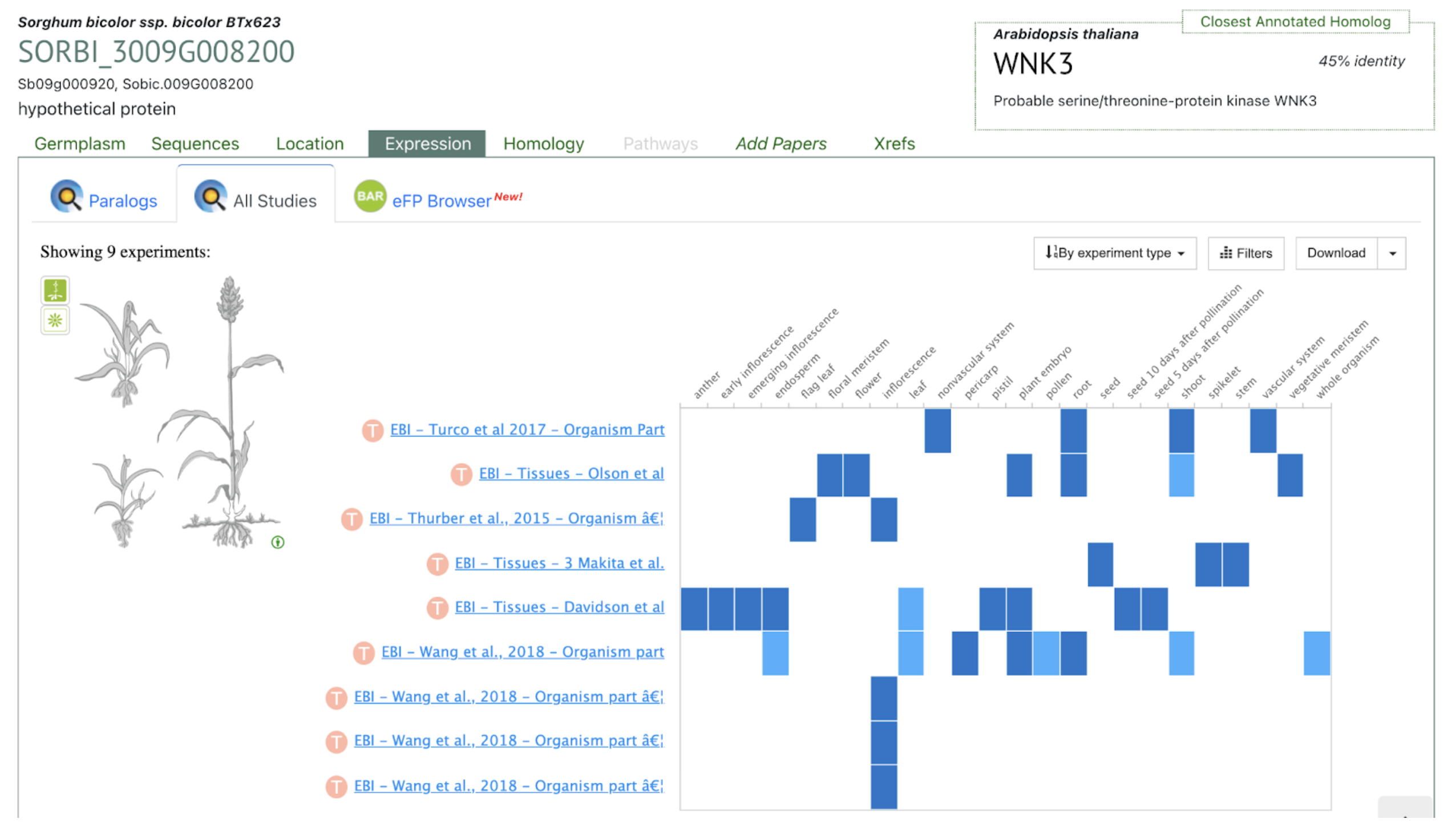
Figure 2: Expression profile of SORBI_3009G008200 across Sorghum bicolor tissues. Gene expression data aggregated from nine RNA-seq studies (e.g., Turco et al., 2017; Olson et al.; Thurber et al., 2015; Wang et al., 2018) show that SORBI_3009G008200 is transcribed in multiple developmental and organ-specific contexts, including root, leaf, inflorescence, and seed tissues. Stronger expression is observed in vegetative meristem and root samples, suggesting potential roles in early growth and tissue differentiation. The right panel summarizes presence/absence and relative intensity of expression across plant organs, with darker blue indicating higher transcript abundance. These spatial patterns support a functional role for SORBI_3009G008200 (a WNK3-like kinase) in signaling networks active during vegetative and reproductive development.
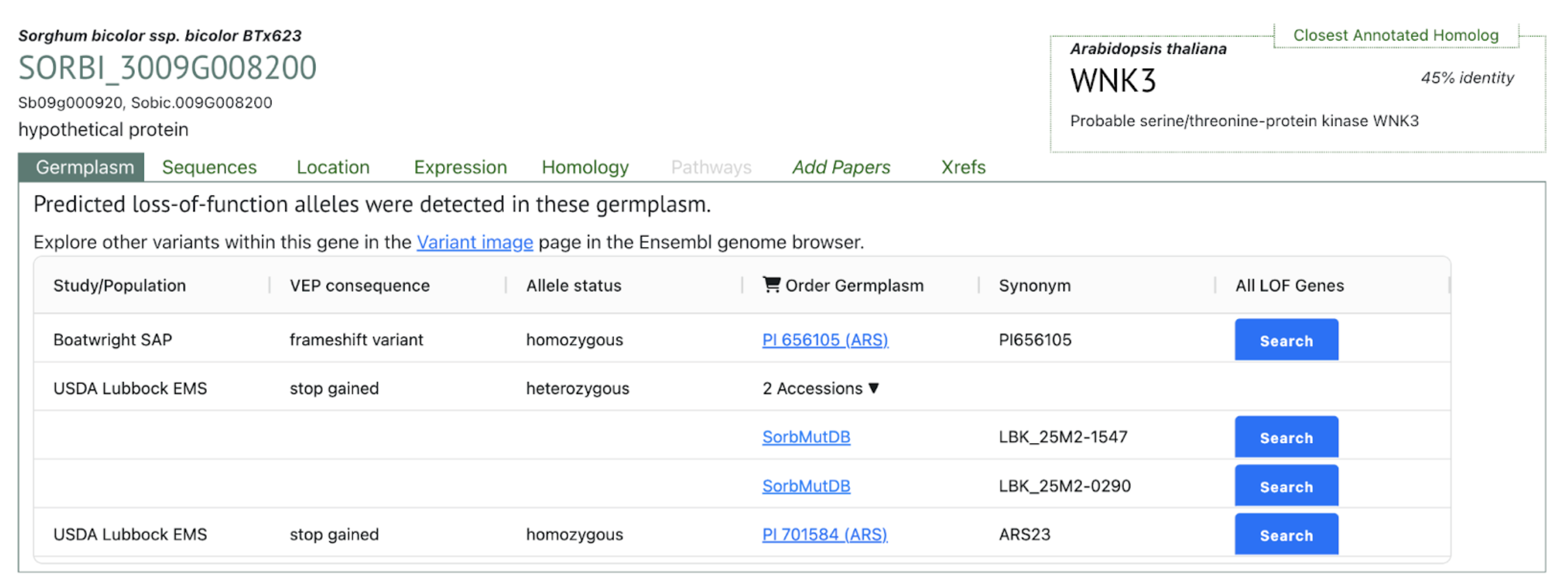
Figure 3: Predicted loss-of-function alleles for SORBI_3009G008200 identified in diverse Sorghum bicolor germplasm collections. Variant effect prediction (VEP) analysis in SorghumBase reveals multiple deleterious alleles affecting this gene, including frameshift and premature stop-gain mutations. These variants were detected across the Boatwright SAP and USDA Lubbock EMS populations, with both homozygous and heterozygous states represented. Germplasm accessions such as PI 656105 (ARS) and PI 701584 (ARS23), along with EMS-induced lines LBK_25M2-1547 and LBK_25M2-0290, carry disruptive mutations that may impair gene function. Given that SORBI_3009G008200 is a putative WNK3-like serine/threonine-protein kinase, these alleles provide valuable genetic resources for investigating kinase-mediated signaling pathways and their potential roles in root angle (RA) quantitative trait variation.
Reference:

Mitiku AD, Feyissa T, Woldetensaye AT, Chikssa HN, Menamo TM, Abebe TM, Bante K. Multi-locus genome-wide association studies for root system architectural traits in Ethiopian sorghum (Sorghum bicolor L.) landraces. BMC Plant Biol. 2025 Sep 2;25(1):1180. PMID: 40890595. doi: 10.1186/s12870-025-07271-6. Read more

Genetic Dissection of Root Architectural Traits in Ethiopian Sorghum Landraces Reveals Key Loci for Drought Resilience

Leave a Reply

Your email address will not be published. Required fields are marked *