Sorghum submergence tolerance is governed by a WRKY76–miR528–SOD2 regulatory module that controls oxidative stress responses, revealing key molecular targets for improving crop resilience to flooding.
Keywords: ROS scavenging, SOD2, Sorghum, WRKY76, miR528, oxidative stress, submergence tolerance
By elucidating a WRKY76–miR528–SOD2 regulatory module that governs oxidative stress homeostasis during submergence, this work provides a mechanistic framework for improving sorghum flooding tolerance and offers actionable molecular targets for breeding climate-resilient crops in an era of escalating flood risk. – Meng
Flooding caused by climate change increasingly threatens global crop production by reducing light and oxygen availability, thereby impairing photosynthesis and aerobic respiration. Although sorghum (Sorghum bicolor) is broadly resilient to abiotic stresses due to its African evolutionary origins, the molecular pathways underlying its adaptation to flooding remain inadequately defined. Using diverse sorghum germplasm, scientists from Shanxi Agricultural University, the Chinese Academy of Sciences, Guizhou Academy of Agricultural Sciences and Shandong Agricultural University identified substantial variation in flooding tolerance and revealed a regulatory cascade centered on WRKY76, miR528, and SOD2 that modulates oxidative stress responses during submergence. Tolerant accessions showed reduced WRKY76 expression, which limited the accumulation of miR528—a negative regulator of reactive oxygen species (ROS) scavenging that directly targets SOD2. This regulatory balance enabled more efficient ROS detoxification, promoting survival and recovery. Beyond miR528, additional miRNAs, including miR171, may contribute to submergence responses, highlighting the complexity of post-transcriptional regulation during flooding.
miR528 is a monocot-specific small RNA with diverse functions in stress tolerance, development, and pathogen defense, yet its role in flooding response had not been previously documented. Here, excessive MIR528 expression impaired submergence tolerance by reducing SOD2 levels and weakening ROS scavenging capacity. To uncover upstream regulators, the study identified W-box motifs in the SbMIR528 promoter and demonstrated that WRKY76 binds to these elements to activate MIR528 transcription under submergence. Variation in WRKY76 expression across sorghum accessions likely contributes to differences in miR528 levels and flooding tolerance, though the upstream regulators of WRKY76 itself remain unknown. As WRKY transcription factors often function within broader regulatory networks, WRKY76 likely influences additional genes involved in ROS homeostasis. Collectively, these findings establish the WRKY76–miR528–SOD2 module as a key mechanism controlling sorghum submergence tolerance and provide promising targets for genetic improvement of crops cultivated in increasingly flood-prone environments.
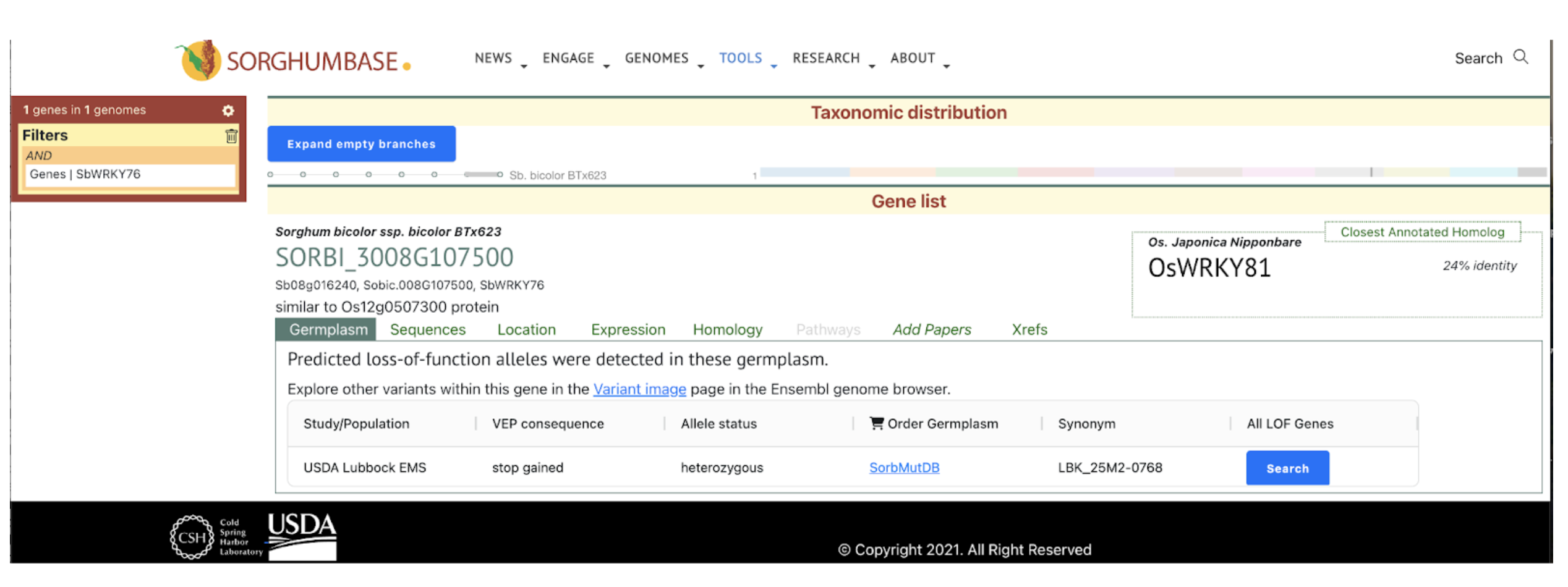
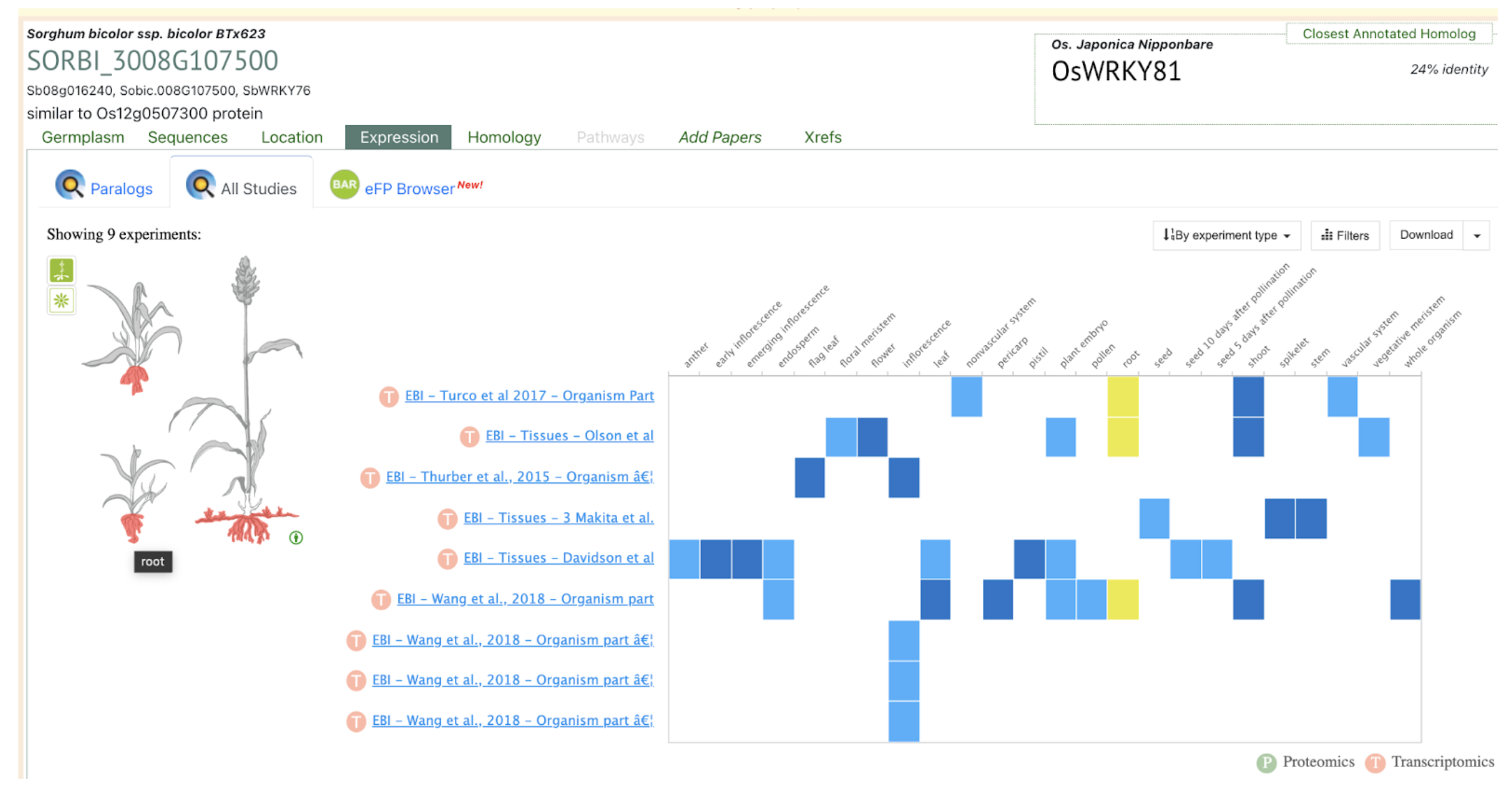
SorghumBase Examples:
Reference:
Meng X, Xu Y, Hao R, Fu X, Ding Y, Zhao R, Dai L, Zhang H, Zhou Y, Zhang L, Hu R, Sui N, Kong Z, Li A, Li S. The WRKY76-miR528-SOD2 module: regulating submergence tolerance through ROS scavenging in sorghum. New Phytol. 2025 Nov;248(4):1841-1856. PMID: 40906703. doi: 10.1111/nph.70542. Read more