The sorghum genotype ‘S208’ exhibits superior waterlogging tolerance through coordinated activation of anaerobic energy metabolism, hormone signaling, and cell wall remodeling that drives adventitious root formation and aerenchyma development under hypoxic conditions.
Keywords: RNA-Seq, WGCNA, adventitious roots, anaerobic respiratory enzymes, sorghum
Waterlogging imposes severe hypoxic stress on plant roots, disrupting aerobic respiration, depleting energy reserves, and impairing growth. By integrating morphological, physiological, and transcriptomic analyses, researchers from Shanxi Agricultural University and Taiyuan Normal University compared the responses of two sorghum genotypes differing in waterlogging tolerance: the sensitive ‘S015’ and the tolerant ‘S208’. The results demonstrate that ‘S208’ exhibits superior tolerance, characterized by faster adventitious root emergence and greater aerenchyma formation, which enhance internal oxygen diffusion under submerged conditions. These anatomical adaptations mitigate hypoxia and sustain root function, highlighting the importance of structural plasticity in waterlogging resistance. Physiologically, waterlogging induced a shift toward anaerobic metabolism in both genotypes; however, ‘S208’ showed significantly higher activities of pyruvate decarboxylase (PDC), alcohol dehydrogenase (ADH), and lactate dehydrogenase (LDH), supporting more efficient ATP production and redox balance under oxygen-limited conditions.
Transcriptomic analyses further revealed that ‘S208’ mounts a stronger and more coordinated molecular response to hypoxia. Genes involved in carbohydrate metabolism, including sucrose synthase (SUS1) and trehalose-6-phosphatase (T6P), were more highly expressed in ‘S208’, suggesting enhanced mobilization of energy reserves. Upregulation of glycolytic and fermentative genes, particularly ADH and PDC, reinforced the central role of anaerobic respiration in tolerance. Additionally, genes associated with cell wall modification (e.g., XTH24, XGT9) and hormone signaling pathways involving ethylene, auxin, and ABA were more strongly induced in the tolerant genotype, linking transcriptional regulation to aerenchyma formation and adventitious rooting. Weighted gene co-expression network analysis identified ERF071 and WRKY72 as key hub transcription factors potentially coordinating these responses. Together, the findings outline a hierarchical adaptive mechanism in ‘S208’ that integrates early transcriptional activation, sustained metabolic adjustment, and morphological remodeling, providing valuable targets for breeding waterlogging-tolerant sorghum cultivars.
SorghumBase examples:
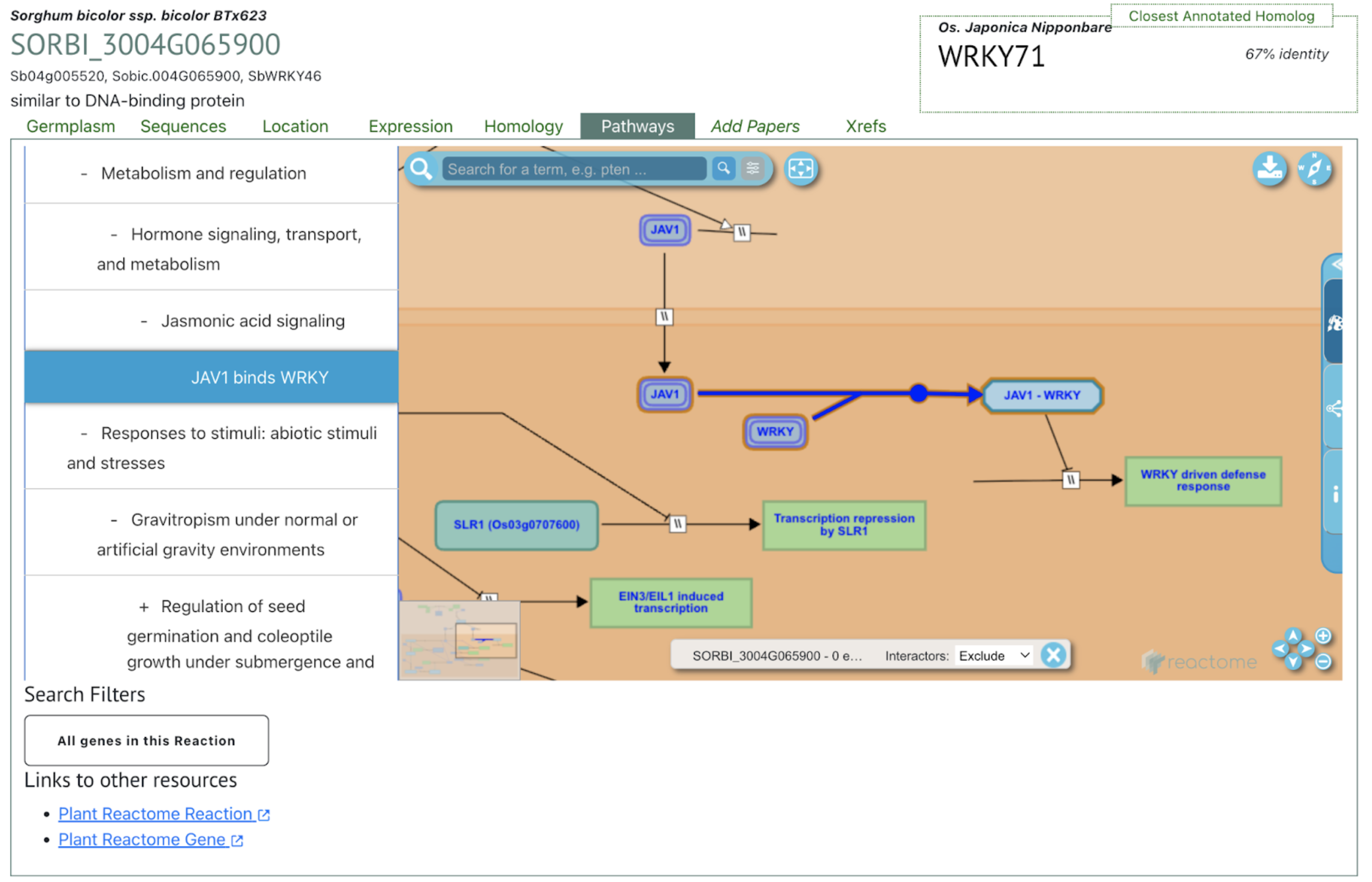

Reference:
Zhang R, Chen H, Li X, Wang M, Luo Y, Jiao W, Chang J, Cao X, Feng J. Integrated morphological, physiological, and transcriptomic analyses uncover the mechanisms of waterlogging tolerance in Sorghum bicolor (L.). Front Plant Sci. 2025 Dec 8;16:1706603. PMID: 41439183. doi: 10.3389/fpls.2025.1706603. Read more