A genome-wide association study of sorghum seedlings under salt stress identified 35 loci and 39 candidate genes—many conserved across species—implicated in salt sensing, ROS detoxification, osmotic adjustment, and K⁺/Na⁺ homeostasis, providing targets for improving salt tolerance through molecular breeding.
Keywords: GWAS, mini core, salt tolerance, seedling, sorghum
Salt stress severely constrains sorghum seed germination and early seedling growth, limiting yield in saline soils. To elucidate the genetic basis of salt tolerance at this critical developmental stage, scientists from Anhui Science and Technology University, International Joint Research Center of Forage Bio-Breeding in Anhui Province, The International Crops Research Institute for the Semi-Arid Tropics (ICRISAT) and University of Louisiana at Lafayette employed a genome-wide association study (GWAS) using a sorghum mini core collection which was genotyped with over six million SNPs. Seedlings were evaluated across multiple sodium chloride (NaCl) concentrations and years for a comprehensive set of growth-related traits. GWAS analysis of 84 traits–treatment–year combinations identified 35 salt-tolerance loci. Notably, the strongest association (Locus 8–1) resided in a non-coding genomic region, highlighting the potential regulatory role of non-coding variants in stress adaptation. Among the remaining loci, 39 candidate genes were identified from 29 loci, of which 29 possess orthologs previously implicated in plant salt tolerance, supporting their functional relevance.
Functional annotation revealed that many candidate genes are associated with key physiological processes involving salt stress responses, including salt sensing, reactive oxygen species (ROS) detoxification, osmotic adjustment, and ionic homeostasis. Genes encoding receptor-like kinases, antioxidant and DNA repair proteins, fatty acid hydroxylases, and multiple enzymes of the flavonoid and anthocyanin biosynthesis pathways are consistent with roles in stress signaling and ROS scavenging. Several loci harbor genes involved in maintaining K⁺/Na⁺ balance, such as Na⁺/H⁺ antiporters, Na⁺/Ca²⁺ exchangers, response regulators, nitric oxide synthase, and brassinosteroid-related enzymes, emphasizing the central role of ion homeostasis in seedling salt tolerance. Additional candidate genes, including F-box proteins, RNA helicases, lectins, lipases, and ribosomal proteins, point to diverse and partially unexplored mechanisms. These results provide a robust genetic framework for understanding salt tolerance during sorghum seedling development and offer valuable targets for functional validation and molecular breeding.
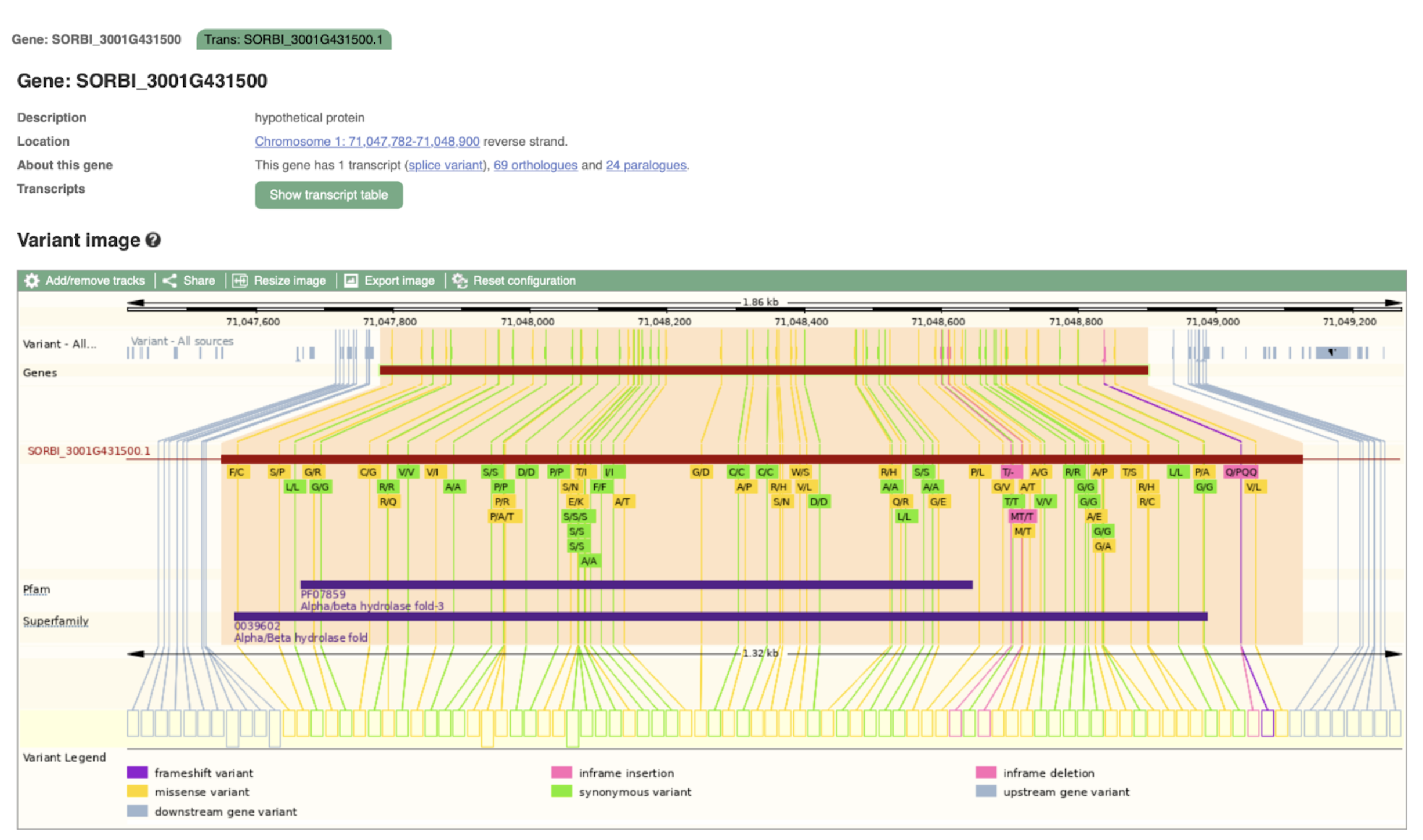
SorghumBase example:
Reference:
Wang L, Xing Z, Zhou J, Jiang M, Fan Q, Yang G, Li L, Wang Y, Habyarimana E, Wang Y, Hu D, Wang YH. Genome-wide association study of salt tolerance in sorghum during germination. Front Plant Sci. 2025 Dec 10;16:1682270. PMID: 41451288. doi: 10.3389/fpls.2025.1682270. Read more